I will draw you with a thousand words
A photographer's interactive gallery installation begins printing impossible messages, leading to an encounter with something trapped inside a masterpiece.
Story Information
Author
Saturdead →Narration
Narration is not currently allowed for this story. Permission may be requested by emailing hello@jinxish.net and including a link to this story.
I will draw you with a thousand words
A couple of years ago, I was a name in the art scene. Not as an artist per se, but as a photographer. I had a collection of prints that were starting to make a name for themselves. As local celebrities and would-be actors stopped by my studio for their headshots, that reputation slowly built up. I was waiting for my big break; and paying the bills along the way.
I’m not gonna share all my personal details, for obvious reasons, but I lived in quite a big city. Not quite Big Apple kind of big, but respectable in its own right. I’d lived there for eight years, jumping from job to job. Sometimes I’d get to work on something more commercial, and I’d slowly eat my way through that check until my toes dipped back into my savings account. It was a vicious cycle, but it was wonderful. Intense. Just like the city itself.
Things took a turn when I heard I was being considered for an exhibition at a local gallery. Nothing was official yet, but I was excited enough to make some commercial prints. I had already figured out my centerpiece. It was this enormous floor-to-ceiling portrait of my most beloved model.
She was wearing a feathery custom-sewn wedding dress where the veil had been tied over the eyes like a blindfold, with blood-strewn white feathers adorning her head like a crown. The photo was taken from a low perspective looking up at her, giving her the look of a towering statue.
I spent days on that perfect print. I had a custom-made frame, and I prepared the text for the accompanying plaque. I tried telling myself that even if this whole thing fell through, this was something to be proud of.
And yeah, the whole thing fell through. Someone else got the exhibit.
I still got a call from the gallery. While they couldn’t host my work, they had heard interesting things about my experimental photography. They asked if I was willing to provide an art installation instead. I didn’t have any ideas off the bat, but I said I did. I could figure something out. An installation was better than nothing. I tried talking them into accepting my masterpiece portrait, but I kept running into walls.
“There simply isn’t space,” the director explained. “But we are rotating exhibits once every four months. I’m sure we’ll have something for you in due time.”
It wasn’t much of a promise, but I’d survived longer with less. Like a squirrel trying to make it through the winter, I had set aside a lot of hope for times like this.
I tried a couple of ideas, but I kept tripping over my own obsessions. Every time I thought I had something good, it turned out to be derivative of something I’d already made. I wanted to make an installation that wasn’t just interesting, but interactive. I wanted to show the visitors something outspoken and personal. Not just to me, but to them. I thought about making something with literal mirrors, but it came off as preachy. You can only hold up so many mirrors to society. After a while they get obsessed with their looks.
I finally came up with a concept I liked. The idea was to take a camera and hook it up to a motion sensor. Once you sit down in front of it, it takes a picture. It analyzes the photo and prints out a paper with a message based on what’s seen. I figured it was a fun counter-position to the art in the exhibition; instead of you looking for meaning in the art, the art looks for meaning in you. It translated you to words. But I didn’t want to incorporate machine learning or language models, so I had to come up with something else.
I got in touch with the gallery’s resident poet, a man called Theo. He wrote messages and descriptions about all works of art posted in the gallery, and he had a permanent corner in one of the exhibits. It was almost funny, you couldn’t go through a single room without seeing something he’d made, but it was the kind of invisible work that rarely gets a nametag. I had this idea of using all the descriptions Theo had written in the gallery and compiling them all into a database. That way the printed text wouldn’t feel out of place to the aesthetics of the gallery at large.
I ran the installation idea by the director, and he was ecstatic. I got the go-ahead to make a database. Theo sent over years of files, showing nearly everything he’d written during his years working at the gallery. After that it was a matter of listing keywords, cataloging, tagging, and handling errors. It took me a lot longer than I’d like to admit, but I managed to automate it a bit.
After a couple of testing sessions, I was ready to go live. I took my installation down to the gallery to show it off in person.
It was a late Wednesday evening. I could tell some kind of game was playing based on the many people in matching jerseys. April rain was coming down. I carried my equipment under my arm, apologizing as I bumped into the occasional group that refused to move out of the way.
A security guard let me in and closed the doors behind me, locking them. All the lights were on, but it was eerily quiet. Just a vague echo coming from the far-left corridor, short of the entrance hallway. The security guard tapped my shoulder and pointed that way, quietly letting me know where to go.
There were some people already there. There was the director, his adult son, two elderly women, a tall man, and a young woman. I recognized the tall man as Theo, the resident poet. It didn’t take me long to recognize the young woman as Eliza; the one who’d gotten the exhibition spot in my stead.
That’s when I realized why they were all there. It wasn’t to check out my installation; they were setting up her exhibit. It took them a full minute to realize I was even there. When they finally did, their mouths curled up into smiles, but their eyes didn’t move. They were putting on a show.
Eliza was trying to convince the director that one of her paintings would be a better centerpiece than the one he’d argued for, and the two elderly women seemed to be debating what even constituted a painting to begin with. As I began unpacking my equipment, Theo came up to me.
“Hope my work didn’t give you too much trouble,” he said. “Did you get what you need?”
“We can update the database later if we want, it’s fine. Consider this a prototype.”
I set up the tripod and screwed down a metal square on the top. Then I wrapped it in black cloth, giving it the impression of a tall rectangular box. I clicked in the camera up top, with a laptop on the floor underneath. I hooked up a small receipt printer on the side, pulled up a couple of cords, and connected it. It took me a while to get access to the wi-fi, but after that, I was good to go.
“You mind grabbing a chair?” I asked.
Theo nodded and came back with a stool. He placed it a couple of feet ahead of the camera according to my directions. After a couple of seconds, an audio message chimed, telling me the motion sensor was primed and ready. I pointed at the stool and had Theo sit down, adjusting his round glasses.
Then, the camera flashed.
The whole thing worked beautifully, and the flash caught the attention of the others. The flash wasn’t strictly necessary, but I had to clearly show the visitors when their picture had been taken. The whole thing was automated, and thanks to using a small receipt printer, I could have it make literally hundreds of texts per day. The machine ran the algorithm and buzzed to life, printing out a roughly thousand-word description of Theo, using a database of his own poems and descriptions from around the gallery.
He took the printout and read it, his eyes going wide.
“This is amazing,” he said, pointing at the slip of paper. “Can I keep this?”
“That’s the idea,” I said. “About a thousand words, your words, from all over.”
“Can I try again?”
“It’s gonna say the same thing. It’s based on your features.”
“What if I make a face?”
“It’s not that advanced.”
Theo laughed at that. From the other side of the room, Eliza cleared her throat. We all turned to her, the director included. She pointed at me like she was trying to shoot me with an invisible gun.
“We’re keeping that camera thing outside the exhibit, yes?”
“We have an assigned a space for it here by the entrance,” the director said, showing a square outlined by tape. “It doesn’t take up any wallspace.”
“We’re not using the folding screens? We decided against that?”
“I’m sure we can work something out.”
“I would love to hear about what else you decided on when you ruled against the folding screens,” Eliza smiled. “I would love that.”
I ended up working with Theo in the adjacent room. The director was busy trying to reel Eliza back in, but it was clear there was some kind of disagreement. She’d gained some success online in the past year or so thanks to her classical Kahlo-inspired portrait style, but it was clear she was seeing this whole thing as her doing the gallery a favor rather than the other way around. I ignored them, focusing on calibrating the auto-focus while Theo brainstormed a description.
“We’re gonna need a sign,” he said. “And a name. Does it have a name?”
“Does it need one?”
“We need to refer to it somehow. How about…”
He showed me his notebook. At the very top was the phrase “I will draw you with a thousand words”. Underneath was about half a dozen variations of that phrase. I pointed at the top.
“We should use that one. That’s good.”
“It is?”
“Yeah,” I nodded. “Tells you everything you need to know. Good one.”
He smiled at that. And this time, the smile reached his eyes.
It took a couple of days to get Eliza to budge on sharing the space. They bribed her a little by extending her minimum time to six months, with a possible extension. Once she agreed, there wasn’t much time to set up. Theo made a sign for me and tried to keep the instructions simple. He had impeccable handwriting.
“Sit down. Wait for the beep. Keep the print.
I will draw you with a thousand words.”
We had to turn off the camera flash on the first day as it bothered the other guests. Eliza argued that we ought to turn off the sound as well, but I couldn’t figure it out. I could probably put some tape over the speaker, but frankly, she could go to hell. She could afford it. She made more in a week than I made in a month.
Despite the drama, the “Thousand Words” installation was quite the hit. I got a message from the director about people lining up to try it, and they loved getting a little piece they could take home. There was a slight issue with some words becoming repetitive (there are only so many ways you can describe brown hair), but Theo offered to help me update the database. He had a private collection of poems and prose that he was willing to share.
All in all, it was going pretty well. I got paid for my work and the installation could keep going as long as there was someone around to change the printing paper.
I dropped in to check on Eliza’s work too. For all her issues, she was talented, there was no denying that. She had this diamond-in-the-rough kind of quality that made all her work extraordinarily human. You could get a sense of who she was just by her brush strokes.
A lot of people enjoyed the Thousand Words installation too. It felt a bit cheap in comparison to Eliza’s work, but even the gaudiest of visitors couldn’t stop their curiosity. We ended up having to get more paper, and the only major complaint I heard was that a couple of people had gotten unfavorable descriptions. We had to trim the database a bit. The recognition software got confused when people wore unusually large shawls.
I still had to come home to my centerpiece resting against the wall, with no space to be hung. I loved that photo; it evoked something primal in me. I had plenty of other things to show, but that one cut straight to my heart. Not being able to share it with the world never stopped hurting. The composition. The frame. The towering angel.
Once the installation had been up and running for about two weeks, I had to come in for maintenance. The laptop kept overheating under the black cloth, so I had to improve the cooling. Worst-case scenario, I had to remove the cloth entirely. I decided it was best to work on-site, so I got there later in the evening. The security guard let me in; the director had phoned ahead.
It’s eerie to walk through that kind of space on your own. Your footsteps echo against every tile. Even the lighting feels different. They have these bright overhead lights that they only use during off-hours, making the whole building feel like a hospital.
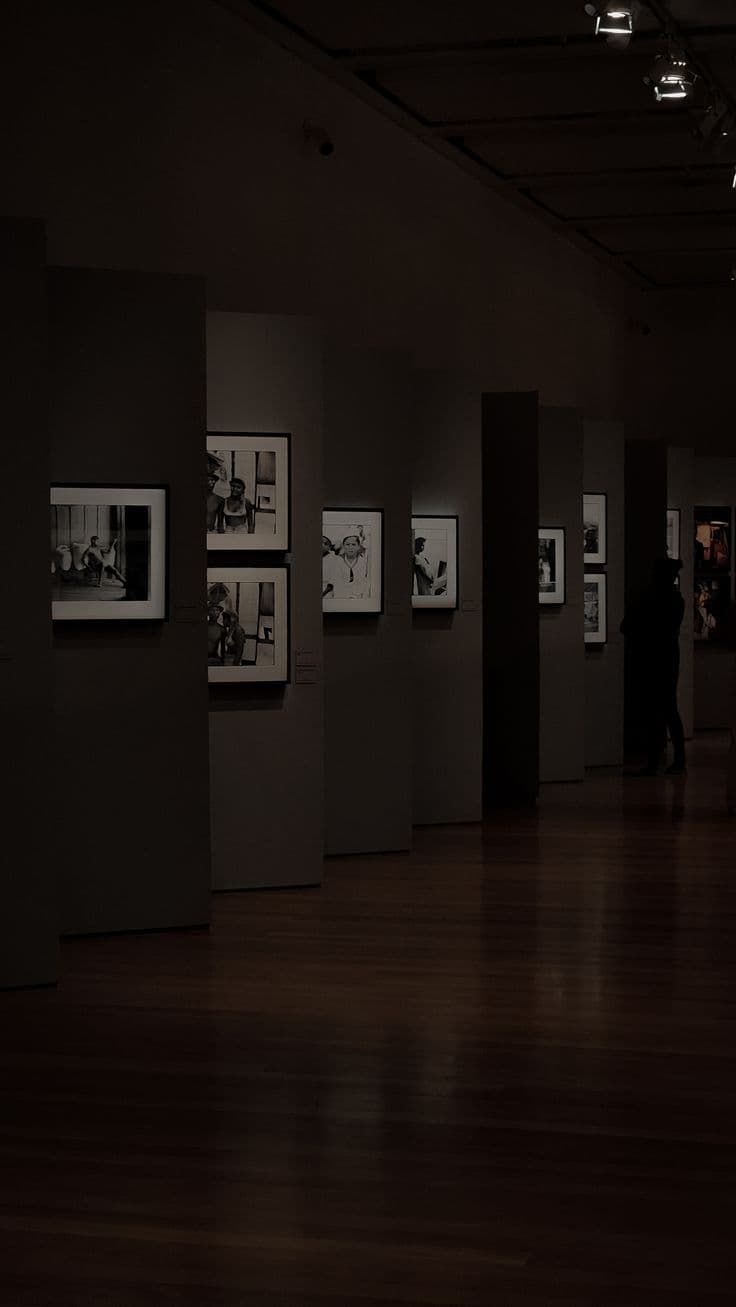
I walked into Eliza’s exhibit, watching her creations under a harsh light. It was bright enough for the brushstrokes to cast a shadow. Meanwhile, my installation had been delegated to the side, so as to not take up the center space. No one had told me they’d moved it, but there wasn’t much I could do about it.
I peeked my head under the black cloth and checked the computer. The thing was still running. Then I heard a click.
Looking up, there was no one else there. But the motion sensor had reacted to something. Something was being printed.
It wasn’t a thousand words. Nowhere near. It was just one sentence, followed by a whitespace.
“A radiant exterior masks your demented machinations.”
That’s all it had to say.
I tried the installation myself, and it worked just fine. The guard was on the other side of the building, I could hear his echoing footsteps. It was just me and the paintings. I read the line again.
I’d cataloged a lot of Theo’s work, and I couldn’t remember that one particular passage. The photos auto-delete for privacy reasons, so I couldn’t tell what the camera had actually seen. I kept that paper slip, chalking it up to some kind of algorithmic hiccup. Maybe a fly passed by the lens, tricking it.
And yet…
Asking around the gallery, I heard that this wasn’t the first time they’d noticed something unusual. Sometimes they found my installation running in the morning, but attendants swore they’d turned it off the night before. They figured it was human error. It’s easy to forget a laptop.
But that one phrase wasn’t an isolated incident. Sometimes the attendants would notice a printout or two waiting by the machine. Sometimes it was nothing, but other times, it was that same message.
“A radiant exterior masks your demented machinations.”
They’d saved the printouts for me. There were at least six of them. It wasn’t really a problem, but if it was a bug it was better to fix it now rather than later. I wasn’t sure it was worth fixing, but I decided it couldn’t hurt to try. I didn’t really have much going anyway, and being on good terms with the gallery might bump my chances of getting an exhibit of my own.
I talked to Theo about it. We sent about 20 e-mails back and forth, trying to figure out exactly where this one phrase originated. He wasn’t sure himself. Some of the stuff he’d sent me was from exhibits that weren’t even around anymore; it was a sort of collected archive of poems and descriptions he’d accumulated over the past few years.
I got a call from him one evening as I was out grocery shopping. I had my headphones on, browsing through the produce section. The owner knew me by name, I shopped there all the time.
“I think I found where it’s from,” Theo said. “Partly, at least.”
“Alright, let’s hear it.”
“It’s quite old,” he admitted. “When I first started at the gallery I used a more abstract style. I liked it, but the director thought it ‘imposed unnecessary weight’ to the pieces, so we settled for more… generic descriptions.”
“What did it describe?”
“See, that’s the thing. It doesn’t describe a single art piece; it describes the gallery itself. It was a phrase I wrote for a sign during one of our renovations. The full quote is…”
I could hear papers shuffling in the background. There were a lot of papers turning; I could tell Theo had been at this for a while.
“The full quote is ‘Pardon the interruption faithful observer, as our radiant exterior will soon come to house new demented machinations’.”
It wasn’t much, but at least I had a source. When I’d imported Theo’s texts, it had all been these random text files. I hadn’t even checked the dates. Some of the text I’d imported lacked descriptive tags to latch onto, so there was no reason for this one phrase to pop up again and again. If it was an old one, I figured it might be some kind of database error. It might have accidentally ended up as the first or last entry, and it just defaulted to it.
It was a start, but far from over.
A couple of days later, the director called me. This wasn’t unusual in and of itself, but he insisted we speak in person. I came down at closing time, watching the visitors leave through the gift shop. The director waved me over, leading me into a more private space through the storage in the back.
“It’s about the installation,” he said as he absent-mindedly browsed one of the shelves. “It’s quite the hit. We’re considering buying it permanently.”
“That’s wonderful news.”
“It is,” he agreed. “But it comes with a few stipulations. It’s a similar deal to what we’ve offered our dear Theo.”
“Would you care to elaborate?”
He removed an empty plaque from a shelf, looked it over, and put it back.
“It means you can’t be featured for your own exhibit. It’s a policy we had to agree to when signing off on funding, none of those who work here can be part of the exhibitions. It’s to make sure we don’t just sit around patting one another on the back.”
“But I don’t work here. I’ll just have a-“
“A permanent installation, yes. I’m afraid our standardized contract doesn’t take that into account.”
I thought about it. It would close a door, but it’d probably earn me a fair paycheck. I thought about Theo and his work, and remembered a detail.
“Does that mean I get a permanent display space? Theo has one.”
“You would,” he agreed. “It’s not much, but it’s yours. Within reason, of course.”
He showed me a space not far from the exit. It was barely enough to hang a painting, much less my centerpiece. I would have to settle for something smaller, or do something entirely different. Either way, it wasn’t a done deal. I excused myself from the director, telling him I had to think about it.
That evening, as the gallery closed, I was left sitting in Eliza’s exhibit. My installation was still running, and the dim visitor lights were still on. Most had gone home, leaving me alone with the security guard and a couple attendants cleaning up the gift shop. I’d settled on a bench overlooking the room. Real fancy bench, too. Hardwood.
I was so stuck in my own thoughts that I barely noticed Theo joining me. He sat down next to me with a sigh. Before I could ask, he answered.
“The director wanted me to talk to you,” he said. “Try and get you to take the deal.”
“Figures.”
We sat there for a while, looking over the exhibit. In the warm light, the portraits almost looked like windows, showing different worlds on the other side of thin walls.
“It’s not bad,” I admit. “She’s talented.”
“Yeah,” Theo agreed. “Nothing half-assed here.”
“Half-assed?” I snorted. “I thought you writer types were supposed to be more… verbose.”
“I word my best, thank you much.”
That got a laugh out of me.
Then, the camera clicked.
We both looked up, stifling our laughs. A white slip of paper rolled out of the printer, and even from a distance, I could tell it only had a single line written. I could guess which one. Theo squinted at the camera.
“Why’s it keep doing that?”
“No idea.”
He got up, looked a little closer, and then turned his attention forward. I could see him looking over the exhibit. Portraits lining the far walls in an otherwise empty room. He scratched his head as he checked the note. He shrugged.
“The same one,” he said. “It’s the same damn one.”
“I gotta fix that if I’m gonna accept the offer.”
“Are you though?”
Before I could answer, I heard a crack. It reminded me of wood snapping from cold. I couldn’t place the source. There was another sound, like breaking plastic. Then, crackling glass. Theo looked around the room, but neither of us could find a source.
Something popped right above me, and I jumped off the bench. Joining Theo in the center of the room, one of the paintings that’d sat right above me fell from the wall. The frame shattered against the stone tiles.
One by one, Eliza’s paintings fell from the walls. Their frames were breaking at the seams, leaving the canvases exposed. It only took a couple of seconds, but it was like the exhibit was self-destructing. Theo ponted at one of the paintings.
“It moved!”
As the final painting fell and its frame collapsed, I heard the receipt printer roll out another description. Before I could turn to check it, an eerie sound dragged itself along my spine; like someone pressing a jagged knife over glass. As it reached its peak, I felt a thump reverberating through the room, knocking the wind out of my lungs.
The canvases disintegrated. Every. Single. One. Some were so violently shredded that pieces were flung across the room. In a heartbeat, it didn’t look like an exhibit anymore. It looked like a room covered in dead leaves.
It didn’t take long for the security guard to rush in. He sees me and Theo standing in a ruined exhibit and freaks out. I could see his eyes go wide from across the room. He pulls out his gun, screaming at us to sit down, and my mind just keeps spinning. My legs give out and I sit down flat on the ground, accidentally crushing another piece of canvas.
“It moved,” Theo whispered. “The painting. It moved.”
I didn’t know what to think. My tongue twisted into a stone, forcing me to be quiet. The guard was screaming into a radio, and it didn’t take long for chaos to unfold. The police arrived. The director arrived. And not long after, Eliza arrived.
Theo and I sat on one of the benches when she got there. She didn’t seem upset, she just kicked some of the remains around. The director was trying to get hold of the security footage, but they were having trouble rewinding. Meanwhile, Eliza just turned to me and Theo, her eyes glossy. The officer next to us tensed up.
“Where did you put my paintings?” she asked.
I opened my mouth to speak, but I couldn’t untie my thoughts. My heart was beating out of my chest.
“Where are they?” she repeated.
Theo tried to answer but ended up silently waving his hands around. Eliza cocked her head and picked up one of the canvas pieces. Unfolding it, she ran her fingers across the texture of what had once been a portrait of a woman with a vase, holding a blue sunflower. You could still see the corner of the petals.
She looked around the room, and I could see realization dawn on her. Her fingers began to shake. I saw this deeply composed professional breaking at the seams, and it’s like she couldn’t contain herself. She broke down crying. Ugly crying. But as she turned her attention back to me and Theo, I didn’t see sadness. I saw rage.
“I’ll kill you.”
The officer next to us took a step forward, holding up a hand.
“I’ll kill you!”
She burst into a sprint, her mid-length heels be damned. Her hair untangled as this unblinking, unbridled fury scrunched across her face. Another officer had to help tackle her to the ground and drag her out of the gallery, kicking and screaming with every step.
And like my installation, she repeated herself. She was going to kill me. She made that perfectly clear.
Theo and I tried to explain that we didn’t touch those paintings, but we couldn’t explain what’d happened. The footage seemed corrupted, only capturing a couple of still images. You could manually click frame by frame and sort of get an idea, but it would take hours to piece together. They didn’t have enough to arrest me, so I was to be sent home with a warning not to leave town.
Before I reached the exit, the director caught up with me. Without another word, he thrust my entire installation into my arms, pushing me out the door. The laptop hung out underneath, the cord struggling to stay attached. He’d just ripped it out.
I was left standing on the street with the Thousand Words installation hastily disassembled. And from the receipt printer, I could see the most recent printout still dangling.
“A radiant exterior masks your demented machinations.”
I dragged myself home and threw it all in a pile. I collapsed on my couch, sobbing until sleep took me away.
I stayed home for days, living off whatever I had in the freezer. At one point I was just sitting on my couch, eating defrosted sugar peas. My hands wouldn’t stop shaking, but I couldn’t figure out if it was the cold or the nerves. I’d keep reruns going in the background just to fill the screaming silence of my mind with something other than stomach acid and fear.
I checked in with Theo a couple of times, but he didn’t have much to say. No news. No clarity. The gallery couldn’t get any footage of us actually destroying the exhibition, so the investigation stalled. There was no explanation, but they couldn’t pin it on me or Theo. Not that they didn’t try.
I didn’t know what to do. If even the rumor of me destroying Eliza’s collection got out, I’d be done. I might as well leave town. And just by looking at her, I could tell she was going to do everything in her power to destroy me.
About four days after the event at the gallery, I got a knock on the door. It was getting late, so I wasn’t expecting company. I braced myself for the worst. Looking out the peephole, I could see it was one of my neighbors. She lived just down the hall, I’d seen her plenty of times. I’d never had her knock on my door though. I flipped the lock and opened.
“Yes?”
She turned her head to the right. I followed her look, only to see Eliza standing off to the side.
“Here it is,” my neighbor said.
“Thank you, I was so lost,” Eliza smiled. “Have a pleasant evening.”
As my neighbor walked away, I thought about slamming the door shut. Then I noticed the revolver. A small snub nosed one with a silver handle. Eliza’s smile was empty, never quite reaching her eyes.
The rage was still there.
I had no choice but to let her in. She closed the door behind her and locked it. She took a moment to collect herself, letting the revolver rest in the palm of her hand. She ushered me into the living room, where all my gear was still left on the floor.
She pointed me at the couch, and I sat down. I remember not knowing what to do with my hands. Putting them on my knees made it look like I was getting up. Crossing my arms made me feel like a child. I ended up leaving them hanging to the sides, like a puppet.
“She saw you come in here,” I muttered. “There’s a witness.”
“I don’t care.”
She shrugged as her lower lip trembled. She raised her gun so fast that her arm whipped a little, and she squeezed the handle so hard that if she hadn’t kept the finger off the trigger, I wouldn’t be writing this. I could see her knuckles turn white.
“Thirteen originals,” she spat. “Twenty-eight prints, and thirteen originals.”
I wanted to tell her I didn’t do it, but saying anything could set her off. Her finger was off the trigger, but not by much.
“You don’t think I worked for this?” she continued. “You think it’s all Instagram posts and back scratching? I didn’t take a single sponsorship for four and a half years, because I have some goddamn integrity!”
She squeezed the trigger. The revolver boomed, and a cloud of concrete dust settled on my shoulder, inches from my neck.
“You have killed years of work. You have taken literal years of my life, and for what? Jealousy? Is that all it is? You’re jealous?”
I tried shaking my head, but I couldn’t get my body to listen. It knew what could happen if I moved inches to the side. That could be enough for the next bullet not to miss.
Eliza didn’t want me to talk. She rambled about how she’d paid for her own art supplies by working extra at a pet shop. How she’d worked dozens of canvases trying to paint the right thing over and over, only stopping after she finally got it just the way she wanted. How she’d obsessed over her work. Dreamt about it. Lived it. And in her world, I’d taken that all away.
And now, she wanted me to answer for it.
“Give me one good reason,” she said. “Just one.”
She moved her finger to the trigger. I thought about every word I could come up with. There had to be some combination that would get her to put that thing down and step away, but I couldn’t find them. I couldn’t bring myself to say anything but the truth.
“It wasn’t me.”
Her face scrunched up as she raised the revolver.
Then she stopped.
We looked at one another as we heard a strange noise. It was coming from my art installation. Turns out it’d been in standby mode, keeping the battery from getting drained. It must’ve been on its last percentage, running on fumes.
The camera wasn’t pointed toward either of us. It was on the floor, looking in a random direction. The receipt printer was chugging along, making a printout.
I followed the direction of the camera and looked at my masterfully framed centerpiece resting against the wall across the room. And as I looked a little closer, I noticed something.
It was moving.
Not the frame, or the print. The model in the picture.
I jumped as the frame toppled over, smacking into the floor with a bang. Eliza turned her attention to it, swinging the gun around.
“It wasn’t me,” I repeated under my breath. “It wasn’t me.”
Looking at me, and then back at the frame, Eliza stepped forward. She raised her foot and brought it down as hard as she could, attempting to assert whatever vengeance she could against my work.
But as her foot came down, something moved. It moved suddenly and with enough force to knock her off balance; sending her reeling to the floor.
The frame slowly lifted itself upward as something pushed itself out from underneath. An impossibly long arm reached out and dug its fingers into the floor, trying to get enough grip to pull itself forward. Little by little, this enormous figure pulled itself free from my print.
It was easily eight feet tall. A custom-sewn wedding dress, with a veil tied as a blindfold, and a crown of bloodied white feathers. But it looked nothing like the model I’d photographed years earlier; it was the literal picture. It retained the inhuman proportions brought by the perspective of the photo, its arms bigger and longer than what ought to be possible. A long, outstretched head like the flame of a candle.
The camera clicked again. Another printout. Eliza was in shock, having crawled up against the wall. She held her gun out like a crucifix. I crawled off the couch, across the floor, and read the printout. The first one was exactly the one I expected, but the second one was different.
“How I wish to kiss your brilliance with but a thousand tears of joy.”
Its hand flung out across the room. I hadn’t realized how large it was. It grasped Eliza and pushed her up against the wall, knocking the air out of her lungs. I could hear her gasping for air from across the room. There was another printout.
“The character of a debased gorgon.”
It was pressing her harder, moving closer. It was going to crush her. She lost control of her arm and dropped the gun, letting it fall to the floor. She was well over a foot off the ground.
“A sacrosanct talent. Golden, yet miserable.”
The camera wasn’t even clicking anymore. This was no longer descriptions of what I was seeing, it was communication. It was whatever words this thing wanted to convey. And as its long head swayed like a cobra, my tongue loosened. Before it snapped Eliza’s ribs, I spoke up.
“Please,” I whispered. “Don’t kill us.”
It dropped her like a sack. She collapsed to the floor, gasping for air. This enormous creation turned towards me, and the printouts continued. I read it out loud, giving it a voice.
“A House that longs for a blessing. A Soul demanding of beauty.”
I read it again, looking up. This thing could barely stay upright. It wasn’t natural.
“A house,” I continued. “The gallery?”
A finger reached out, stroking my chin. The texture of warm, wet, paper. The closest thing to a ‘yes’ I could get.
“You’re from the gallery. You want something. From me.”
It almost knocked itself over. I could see it now. I could understand.
This thing had been in the gallery. It had wanted me to exhibit my work. It hadn’t wanted Eliza’s. It tried to show me its disdain through my installation. When nothing seemed to work, and I was on the verge of signing away any chance for a future exhibit, it stepped in. Theo saw it move in the portraits. That’s what must’ve triggered the camera; movement in a place we didn’t look.
It had stopped me from signing away the possibility of an exhibit. And now that my life was on the line, it intervened again.
“Okay,” I whispered. “If you want it, I’ll… do something.”
It stroked my chin again. I’d seen that photo a thousand times. I knew every inch of it. Every contour, every contrast. And with the blink of an eye, the model rested back in its frame like nothing had happened.
We sat there in the dark, letting the realization settle. We’d been approached by something inhuman.
Eliza and I just… moved on. This whole thing was beyond us, and there was no point in looking at this like rational human beings. She didn’t press charges about the gallery. I didn’t press charges about my home. We just looked the other way and silently decided that we’d never look back, or talk about this, ever.
The next day, I got a call from the director. He was clearly shaken, but his message was simple. If I wanted it, I’d have an exhibit at the gallery. Permanently. I accepted, and the moment I did, he hung up the phone. He handed in his resignation later that same day.
This was all a couple of years ago. While I moved out of town to get some space, my exhibit is still up. Attempts at changing it or taking it down have failed, for one reason or another. I still get the occasional check in the mail.
It’s not the most popular exhibit. Since it never changes, most visitors have grown tired of it. I hate thinking about it. People who still go to that gallery hurry through my exhibit to get to whatever’s new. They roll their eyes at my work, asking themselves how the hell it could still be up after all these years.
My centerpiece hangs in the center hall, with a spotlight firmly attached. It has a couple of fans, I suppose, but there’s this sense of unease that hangs over the entire room. The guides don’t like to linger too long. The security guard hurries past it at night. It feels like that space isn’t meant for visitors; it’s meant for whatever wants it to stay like it is.
I’m not a photographer anymore. I work in documentary filmmaking. I’m afraid that if I were to pick up a camera, something might reach out to me. I don’t want to create something for that thing to return. That’s not the world I wanted, and it’s not one I intend to return to.
Theo still works there. Not because he necessarily wants to, but because every time he has tried to quit, something has made him come back. I’ve only talked to him briefly about it, and it’s clear he doesn’t want to talk about it.
“It can reach so far,” he told me once. “There’re always pictures. It can always move.”
Eliza still makes things. She moved to another state and changed much of her brand. She’s quieter nowadays. Different. I still get her Instagram reels, but they’re not as vibrant. I guess somber is a better description.
Looking back at this, I think that sometimes our work runs away from us. Be it art, or prose, or craft. It takes on a life of its own and leaves us in the dust, gasping for air. It loves us for what we do in the most destructive way it can, and nothing is safe from its wants.
And to this day there is an art installation running at a gallery in a big city, far away from here. There is a sign next to it, waiting to be read.
Sit down. Wait for the beep. Keep the print.
I will draw you with a thousand words.
Rate this story
How disturbing was this one?